

| Contact Us |
| Name:colin |
| Email:colin@xhhjtech.com |
| T e l:+86 18602602237 |
Pneumatic Mixer Running Slower? It's not that the machine is old, it's those small holes on the bottom plate that are blocked
Pneumatic mixers don’t have mixing blades, they rely entirely on jets of compressed air injected from the bottom to mix materials. Operators often notice mixing times doubling from 10 minutes to 20 minutes, alongside inconsistent mixing quality. Even when air pressure and control systems check out fine, the issue almost always points back to the air distribution plate at the bottom of the vessel.
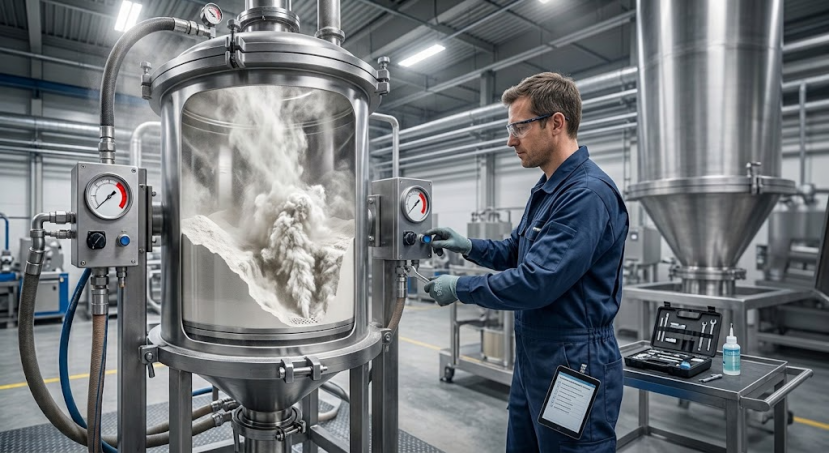
Why Clogged Holes Ruin Efficiency
Every tiny hole in the distribution plate acts as a micro-nozzle. Working together, they create an even airflow pattern across the entire chamber. Over time, fine powder seeps into these holes, forming layers that restrict airflow. When holes clog:
Airflow becomes uneven: Air blasts heavily through the few remaining open holes while leaving other areas completely dead.
Dead zones form: Material in these dead zones stays still and misses the mixing cycle. The machine has to run much longer just to mix these pockets, tanking overall efficiency.
How to Fix and Maintain It
1.Clean the Plate: Empty the machine, remove the distribution plate and blow compressed air through the back of each hole to clear out the trapped powder.
2.Inspect for Damage: Check if any holes are scratched or enlarged by hard particles.
3.Test the Machine: Reinstall the plate and run a test batch. If the mixing time drops back to normal, the plate is good to go. If mixing times remain slow, the hole geometry has deformed and the distribution plate must be replaced.


