

| Contact Us |
| Name:colin |
| Email:colin@xhhjtech.com |
| T e l:+86 18602602237 |
Vacuum Conveyor: Frequent Blockages and Unstable Feeding May Not Be Caused by Pump Power
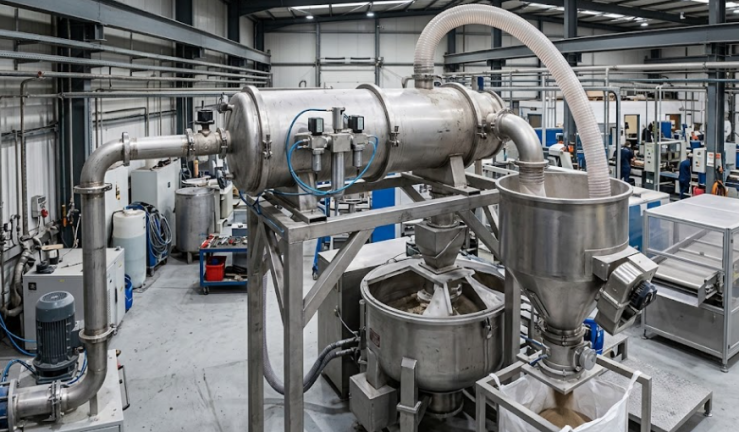
As an independently movable powder-conveying unit, a vacuum conveyor can be installed above mixers, enclosed vibrating screens or storage hoppers without relying on a complete production line.
If feeding is intermittent, pipelines become blocked or conveying capacity drops, many users first assume that the vacuum pump is not powerful enough. In most cases, however, the real issue is a mismatch between the equipment design and the powder characteristics.
The main components include a vacuum pump, storage hopper, pulse filter, pneumatic discharge valveand conveying hose.
Choose the Right Model for Your Powder
Free-flowing powders: A standard batch-type vacuum conveyor is usually sufficient for stable and reliable conveying.
Ultra-fine or cohesive powders: Choose a model with pulse-jet filter cleaning to prevent fine powder from clogging the filter and reducing suction.
Moisture-sensitive or easily caking powders: A vibrating discharge hopper helps remove powder buildup and prevent blockages.
Combustible powders: A closed nitrogen-circulation system helps isolate oxygen and reduce the risk of dust explosions.
Daily Maintenance
Avoid bending or compressing the conveying hose. Minimize 90° elbows, as bends are common locations for powder blockages.
Clean the hopper and filters thoroughly when changing materials to prevent residues from contaminating the next batch.
Regularly check the discharge seal. A worn seal can cause air leakage, reduce vacuum pressure, and affect feeding performance.
Do not simply choose the highest-power vacuum pump. Excessive suction can increase powder loss and accelerate filter wear.Different powders require different airflow rates depending on their bulk density and flowability. There is no one-size-fits-all vacuum conveyor.


