

| Contact Us |
| Name:colin |
| Email:colin@xhhjtech.com |
| T e l:+86 18602602237 |
Born for Fineness: Fully Automated Closed Conveying Solution for Talc Powder Vacuum Conveyor
Talc powder is very fine and soft. But these qualities cause problems during conveying—it creates dust, clogs filters, and wears out equipment. The talc powder vacuum conveyor is made to solve these issues. It uses negative-pressure closed conveying to stop dust and material contamination from the start. It is widely used in ceramics, chemicals, coatings, and other fields.
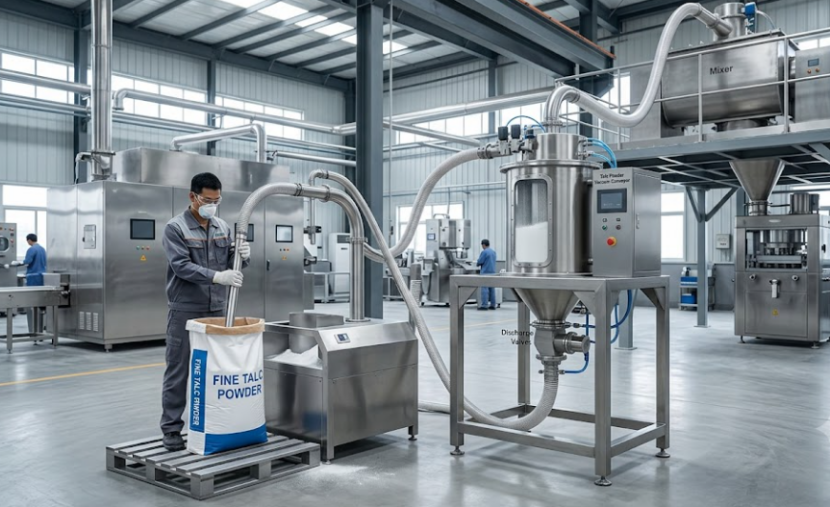
Core Parts and How They Work
The suction pipe and hopper pull material through stainless steel pipes. The suction inlet has a Venturi nozzle to improve the pick-up force. The filtration system has high-precision filters and a pulse reverse-air device that cleans the filters automatically at set times, keeping the suction steady. The pneumatic discharge valve at the hopper bottom opens when material reaches a set level, allowing fully automatic intermittent conveying.
Why a "Special" Design Is Needed
Regular pneumatic conveyors often have problems with talc powder—dust leaks, filter clogs and pipe sticking. The special vacuum conveyor solves these with fully sealed pipes, automatic reverse-air cleaning, and smooth inner walls.
A standard unit has four main parts that work together. The vacuum source gives the negative-pressure power. There are two types: pneumatic (driven by compressed air, good for explosion-proof areas) and electric (using Roots or water-ring pumps, good for large-scale work).
Key Points for Selection
When choosing a unit, look at anti-clogging design (use bin vibrators to stop bridging), material and sealing (contact parts use 304 or 316L stainless steel, seals use wear-resistant fluororubber), and conveying capacity (choose the right power based on distance and height).
Typical Use Cases
Paired with a dust-free feeding station, after manual bag opening, the powder is pulled into the hopper and sent through sealed pipes to high storage bins—this combines "feeding + conveying" with no dust. When feeding mixers or tablet presses, it delivers material on a set schedule and amount, helping to achieve fully automated continuous production.


