

| Contact Us |
| Name:colin |
| Email:colin@xhhjtech.com |
| T e l:+86 18602602237 |
Powder Filling Equipment: What Technical Details Lie Behind Precise Weighing?
Powder filling is the final operation, packaging the mixed powder into containers according to specified weights. The seemingly simple process of "loading and weighing" demands high precision and stability—especially in pharmaceutical and food industries where net content deviations are strictly regulated by national standards. Underfilling is non-compliant, while overfilling increases costs. Thus, precise filling equipment is crucial.
Currently, mainstream powder filling equipment is primarily categorized by metering method into screw metering and weigh-scale metering.
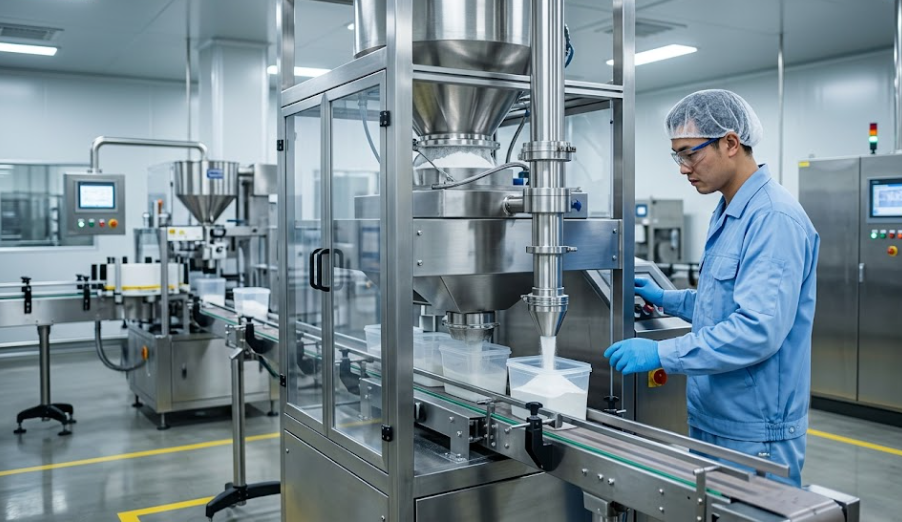
Screw Metering: Efficiency-First Volumetric Metering
Screw metering is the most common volumetric method, controlling the discharge volume via the number of screw rotations, each rotation displaces a fixed volume of powder, so more rotations yield greater discharge.
Its advantages are high speed and efficiency, suitable for large-scale, small to medium-dose filling, such as bagged flour, seasoning powders, and pharmaceutical granules. However, as a volumetric method, its accuracy is significantly affected by powder density and flowability. Fluctuations in these properties can cause deviations in actual weight for a given number of rotations.
Therefore, screw filling machines often incorporate checkweighers that weigh each container, reject off-spec ones, and provide feedback to automatically calibrate screw parameters. Design details to enhance accuracy include: variable pitch/diameter screws for stable discharge; hopper agitators to prevent bridging; and in ultra-fine powder applications, dust collection devices and filling nozzles to minimize dust and feeding deviations.
Weigh-Scale Filling: Precision-First Direct Weighing
Weigh-scale filling directly measures weight. It comes in net and gross weigh types: net weigh involves filling a weigh hopper to the target weight before discharging into the container; gross weigh places the container directly on a scale and stops feeding immediately upon reaching the target weight.
Weigh-scale filling offers significantly higher accuracy than volumetric methods, as it is unaffected by changes in powder density or flowability, ensuring precise weight even with material property variations. It is preferred for high-value powders, large-dose filling, or situations with unstable material properties, e.g., valuable herbal powders, lithium battery cathode materials, and chemical raw materials. Its main drawback is slower filling speed compared to screw systems.
A core challenge in powder filling is dust generation. Ultra-fine powders tend to generate significant dust during discharge, contaminating containers, compromising seal integrity, causing material loss, and polluting the workshop. The prevalent solution involves a combination of negative-pressure dust collection and telescopic filling nozzles: the nozzle descends deep into the container and ascends as it fills, reducing drop height and minimizing dust; integrated suction ports near the discharge point capture fugitive dust simultaneously, ensuring packaging cleanliness and material utilization.


