

| Contact Us |
| Name:colin |
| Email:colin@xhhjtech.com |
| T e l:+86 18602602237 |
Powder Mixing Always Uneven? Avoid These 5 Common Misconceptions
Many companies encounter issues with uneven mixing and batch-to-batch variability. Some blame the equipment entirely, while others blindly extend mixing time, failing to resolve the problem. Powder mixing uniformity is influenced by multiple factors. Avoiding these common misconceptions can significantly improve mixing quality.
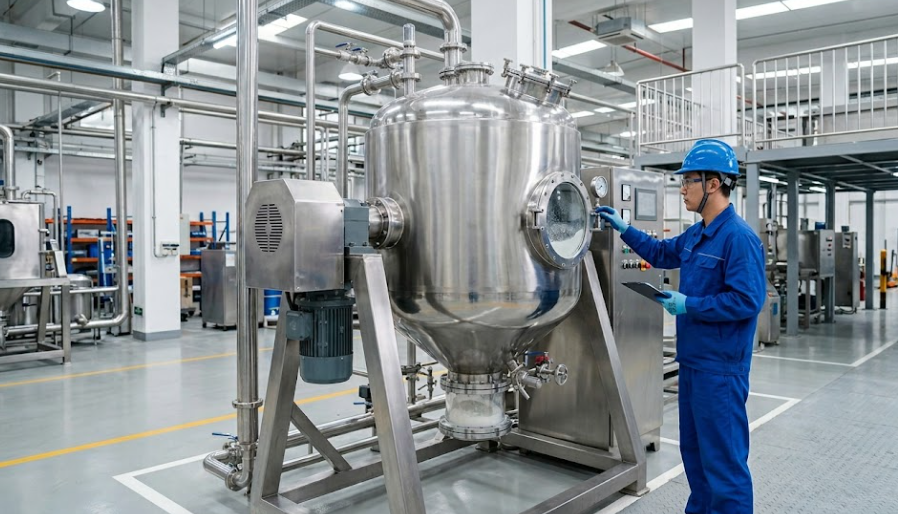
Misconception 1: A Good Equipment Guarantees Uniform Mixing
This is the most common misconception. Mixing equipment is merely a tool; uniformity is first and foremost affected by material properties. If the densities and particle sizes of the components differ significantly (e.g., heavy calcium carbonate powder mixed with light fumed silica), even the best equipment may fail to prevent heavier particles from settling and lighter ones from floating, causing segregation.
Optimization: Pre-mix the small proportion, fine particle component with the carrier material in a specific ratio to create a "masterbatch" before mixing with other components. Reduce mixing speed to minimize segregation probability. For materials with substantial differences, consider adding a small amount of dispersant to improve compatibility.
Misconception 2: Longer Mixing Time Means Higher Uniformity
There is an "optimal mixing time." Exceeding it leads to demixing, especially for materials with particle size or density differences, as prolonged mixing exacerbates segregation.
Correct Approach: Determine the optimal mixing time through trialsat a fixed speed, mix for different durations, sample from multiple points and test uniformity to identify the time yielding the highest uniformity. Generally, optimal times range from 5-15 minutes for three-dimensional mixers and 10-20 minutes for ribbon mixers, but should be adjusted based on the specific material.
Misconception 3: Maximizing Load Increases Efficiency and Doesn't Affect Mixing
Mixing equipment has a rated loading coefficient; overfilling is detrimental. For example, the optimal loading for a three-dimensional mixer is 50%-60% of its total volume, never exceeding 70%. Overfilling leaves insufficient space for powder tumbling and convection, drastically reducing mixing effectiveness and straining the motor. Underloading is also problematic, as inadequate powder mass prevents effective convection, resulting in poor mixing.
Misconception 4: Visual Color Uniformity Means Good Mixing
Judging mixing effectiveness by eye is highly unreliable. For components present in very low proportions (e.g., colors, flavors, active pharmaceutical ingredients), visual inspection cannot determine true distribution and often leads to "visually uniform but locally exceeding content limits" issues.
Standard Practice: Collect samples from multiple locations within the mixer according to standard procedures and assess uniformity by measuring the coefficient of variation (CV) of the content. A smaller CV indicates better uniformity. Pharmaceutical and food industries must verify mixing effectiveness through validated data.
Misconception 5: Thorough Cleaning Isn't Necessary for Product Changeovers
When switching between products, simply sweeping out the equipment can lead to cross-contamination and affect the mixing of the next batch. Ribbon mixers, in particular, have dead zones like shaft ends, the back of ribbons, and wall corners where material can accumulate, interfering with the ratio of the new batch.
Correct Approach: Equipment must be thoroughly cleaned during changeovers. Removable parts should be disassembled and washed; non-removable parts should be blown with compressed air or vacuumed, and wiped with alcohol if necessary. Post-cleaning residue verification should be performed to ensure no cross-contamination before starting the next production batch.


