

| Contact Us |
| Name:colin |
| Email:colin@xhhjtech.com |
| T e l:+86 18602602237 |
Powder Conveying Always Blocking? These Practical Solutions Can Help
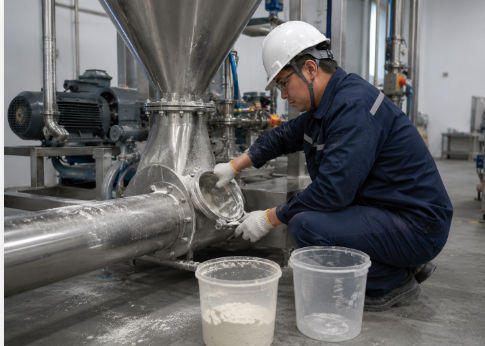
Blockage is the most common fault in powder conveying, ranging from production line shutdowns due to material interruption to equipment overload that burns out motors, and even potential safety hazards from pipeline pressurization and blockage. Powder blockages are not unsolvable; identifying the root cause and applying targeted remedies can significantly reduce their occurrence.
Blockages tend to concentrate in specific locations: pipe elbows, transition sections, discharge ports, and the conical sections of hoppers. The causes vary depending on the location.
1. Blockage Caused by Material Properties
Hygroscopic powders absorb moisture from the air during conveying, leading to caking and adhesion to pipe walls. Over time, this reduces the effective inner diameter and eventually causes blockage.
Solutions: First, control the dryness of the conveying air source by incorporating refrigerated air dryers and filters to remove moisture from compressed air. Second, install vibrators or air cannons at locations prone to adhesion to periodically dislodge accumulated material from pipe walls. For extremely hygroscopic materials, a closed-loop nitrogen conveying system can be used to isolate them from airborne moisture.
2. Blockage Caused by Improper Pipeline Design
Excessive elbows, tees or elbows with too small a bend radius cause a sharp drop in powder velocity, leading to deposition and blockage. Abrupt pipe diameter changes or excessively steep conveying inclines also contribute to material accumulation.
Solutions: Optimizing the pipeline layout is fundamental, minimize the number of elbows and prioritize large-radius bends (with a radius no less than 5 times the pipe diameter). Use gradual transitions for pipe diameter changes, avoiding sudden expansions or contractions. Maintain a slight incline in horizontal conveying pipes to reduce material settling.
3. Blockage Caused by Mismatched Conveying Parameters
In pneumatic conveying, insufficient air velocity fails to fluidize the powder, causing it to settle at the bottom of the pipe. Conversely, excessively high velocity exacerbates material degradation and pipe wear. Blindly increasing the feed rate beyond the equipment's rated capacity also leads to frequent blockages.
Solutions: Adjust conveying air velocity and feed rate according to material density and particle size. Denser, coarser materials require higher air velocities, while ultra-fine powders benefit from lower velocities to avoid dust stratification. Install variable-frequency controlled feeders at the inlet to ensure uniform and stable feeding, preventing instantaneous overfeeding that causes blockages.
In addition, regularly inspecting pipe walls for material buildup, clearing dead zones, and monitoring the pressure and flow of the conveying air source all contribute to maintaining smooth conveying operations.


